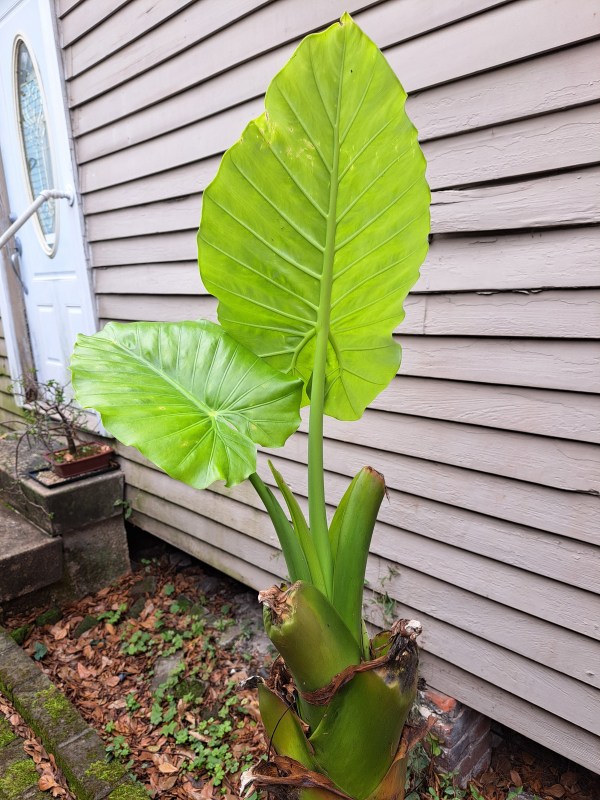
Die Back at the Root

The Brutal Kindness of Pruning

We had snow in January, and it decimated my elephant ear plant, Bert.  I didn’t realize how bad it was until the top half of his stalk fell off. 
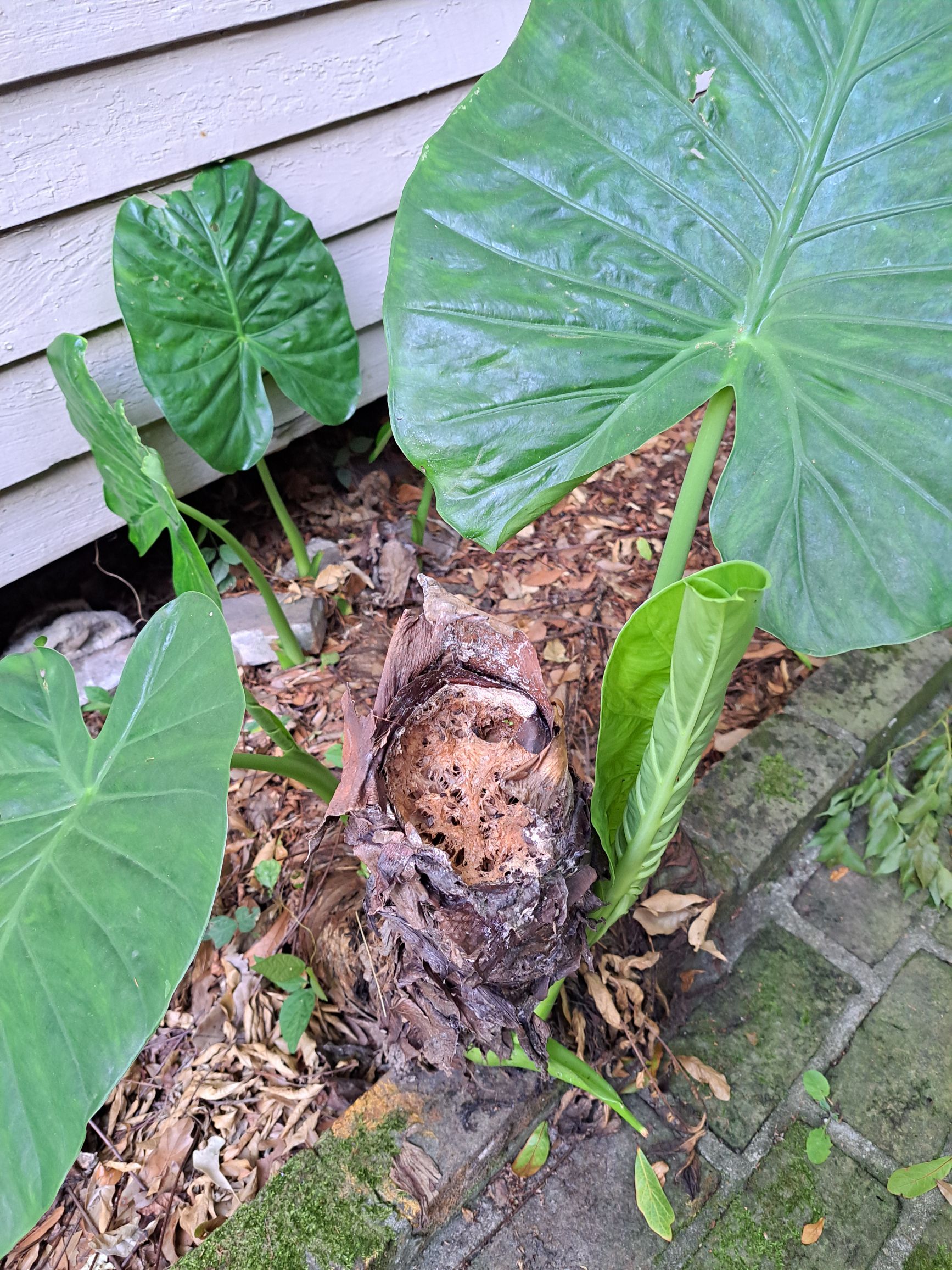
An elephant ear plant with an ugly, rotten trunk

So I had to perform some gruesome but necessary plant surgery, and hack off that dead, rotten trunk so the new shoots can grow.  ChatGPT told me to sprinkle cinnamon on the clean but still horrific wound as an antifungal, so I did that.  It was smelly and slimy and I felt terrible.  I learned from the book The Light  Eaters by Zoe Schlanger that plants hate to be touched.  But it was necessary.  Bert doesn’t have to waste energy on that dying stalk now.  Plants can survive even if they have to die back to the root.

 Humanity at the Brink

I think that might be what human civilization has to do: die back to the root and start over.  

I think history’s verdict will be that in the first half of the 21st century, humanity became so enamored of our technology and endless streaming entertainment that we lost touch with what was truly real.  We are about to be forcibly reminded, as climate change batters civilization to rubble with a never-ending chain of fires, floods and super-storms.  Nation-states will be unable to respond to cascading emergencies.  The insurance industry will collapse, leaving citizens and capital alike unable to recover from disasters.  Those fires and floods will bring famine, plagues and wars. 

 The Uneven Collapse to Come

Not everywhere will get knocked back to the Age of Steam.  High-tech enclaves like Shenzen and Silicon Valley will remain, full of Ais and robots.  But they will be walled from the outside world and still consume more than their share of resources.  They won’t be popular.  

It seems the only way, though.  Die back to the root.  Every structure of our society is so broken, so unjust and extractive, they may be impossible to fix.  They may just have to die.  They seem bent on it, the forces of global capital.  Sucking every last drop of blood out of Mother Earth and her people as they go.

 What Survival Might Require

Those roots we will die back to will be local – our own towns, our own people.  Food, water: the integrity of our land and waters so that we may *eat and drink.* As nation-states collapse, states and then cities will be thrown back on their own resources.   Food you can grow yourself of from the farms outside of town.  Plant-based diets to ease the burden on the Earth.  Localized power like solar cells and other renewables.  Communities looking to their own needs instead of relying on fragile long-distance networks that can be broken by catastrophe at any time.

My novel The Pono Way takes place in the 2090s, about halfway between this world and that one.  Nation-states are still hanging on, barely.  But more and more people are leaning more on their own resources, like the sea-steadings.

The Potential for Regrowth

Once a plant dies or is pruned back, it can concentrate its energy on new growth and recovery.  That is the effect of Dark Ages in human history – they clear away what is dead so something new can grow.  Old structures, old religions, old ways of seeing the world.   Humanity has made it through dark Ages before.  Never with so much at stake, but it probably felt like it at the time.  What could be worse than the Fall of Rome?  Europe and the Mediterranean nursed that wound for a thousand years.

What I hope we gain is, not a learning, but a remembering: we are not above nature, we are in it and of it.  Its flourishing is ours.  From the microbes in our guts to the mycelial networks running through every foot of living soil under our feet, to the phytoplankton in the seas.  All one, cells in the body of Our Mother.  Capitalism and its growth mindset have brought us to the brink of ruin.  I hope we realize, really internalize, believe that we’re all in this together.  Stewardship, not profit becomes the highest value. 

Creative Destruction

The lesson of the dieback is that new hope can come from the ruins.  The collision of the Old and New Worlds was a different kind of Dark Age, brutal and tragic, literally an apocalypse.  But 500 years later a nation of that New World sent men to the Moon.  The historian Yuval Harari said that, even with all its horror, the “discovery” of the New World was the most important event in human history, because it showed all humanity that things we never imagined were possible.  All wisdom was not contained in the mythic past.  We could look forward, to a new horizon.  A New World. That was an epochal change.  

My hope is that we can make it past this new Dark Age, the bitter fruit of our foolhardiness, and civilization on the other side will be better and stronger than before.  More grounded in the earth and the people around us, more wise, more just.  Using science and technology to hallow the Earth instead of despoil it.  Mother Earth is pruning us. 

And yes, it may take 500 years. But the civilization that grows out of that dieback should be the one that can take us to the stars. Just like Bert will grow back as luxurious as before.  This after all is why I write speculative fiction; to look at the future and see how we can change it for the better.  Or what happens if we don’t. 

This Can’t Go On

After Hurricane Ida last month, our power went out for, it turns out, a whole week. The eight major transmission lines for the city of New Orleans and suburbs went through one single decrepit tower, which collapsed under the storm, draping the lines into the Mississippi River and leaving the whole region without power for days.

After a late-summer hurricane it always becomes extremely hot. The storm sucks up all the moisture over the Gulf of Mexico and precipitates it, so after the storm passes, the sky is clear and the sun in August or September is absolutely brutal. And with the power out, no AC. People die in these circumstances. My husband couldn’t handle the heat, so we decamped to his parent’s house north of Baton Rouge. Their power was out for less than a day.

“We can’t keep doing this, ” I said as we drove north, skirting Lake Pontchartrain, the water and sky a vista of blue.

“We can go to my sister’s if we can’t go to Mom’s next time,” he said.

“No,” I said, “I mean Louisiana! This is going to keep happening. These storms that spin up from nothing to a Category 4 or 5 in 48 hours. That’s not enough time to prepare. To evacuate.”

“Nope,” he said.

“And we can’t keep cleaning up these messes. My God, all the power going through one tower, what the hell! It’s climate change. These storms are going to keep happening. We need to harden this place, south Louisiana. We can’t keep getting caught with our pants down. Spending billions of dollars we don’t have for recovery.”

“That’s not going to happen,” he said. Louisiana is a very poor and red state.

“It has to! Somehow.” I looked at the marsh grasses beside the lake, shining in the sun, ideas tumbling in my head. “Maybe I should write a book about it.”

“You just did!” he said.

I did, sort of. Climate change and the ensuing havoc are part of the backstory of THE PONO WAY, an integral part of the character’s lives. The very first page mentions how coffee, real coffee, has become a scarce and expensive luxury. The second page lists a litany of chaos and destruction that is the normal course of events “two centuries into the Anthropocene era of mass extinction and climate change.” The destruction of the environment is part of the background tenor of everyday life in Pono, my island state. It’s largely why Pono was created (it’s an artificial sea-steading) and why many of its inhabitants migrated there, to escape the instability of the mainlands. Including my protagonist, Jake Weintraub.

But the Ponoans come to discover that even a thousand miles of ocean can’t really protect them from the danger and dysfunction of the broken, corrupt remnants of North America forever.

So yes, calling attention to climate change and its ensuing disasters is part of why I wrote that book. Part of why I write at all. My last book was about an epic, civilization-ending apocalypse too. [Daughter of Atlas: A Novel of the Fall of Atlantis, if you haven’t read it yet. 😉 ] And that, too, was caused by unchecked human greed and pillaging of the earth.

It’s important to me. Society has been talking about ecological collapse and doing nothing about it for my entire lifetime. This is my way of doing something.

But there’s more yet to write. I was imagining a story where a bunch of solarpunk misfits take over Baton Rouge and turn it into a green, sustainable, New New Orleans. Baton Rouge is as far north as the Mississippi is safely navigable for the huge container ships that provide so much of Louisiana’s revenue. Far enough north that it won’t be under water in a hundred years. It is the state capitol and a university town, home of LSU, my alma mater. It’s the logical place to migrate to.

Because we will have to migrate, one day. Everyone in south Louisiana. I hope it’s done in a just and peaceful manner. Instead of some kind of Mad Max land rush.

To make something happen, you first have to imagine it.

That’s what I do. You can help me by reading my books, yeah? 😉

Home and safe!

We evacuated subsequent to Hurricane Katrina — er, Ida. Ida hit on the 16 year anniversary of that monster storm. You better believe that was pretty hard for south Louisiana to take.

My husband just couldn’t take the heat without AC, and he has a medical device which needs electricity. So we decamped to his parents north of Baton Rouge. They only lost power for a night.

We were there for about a week, but now we are home: cool, dry, and safe.

Sixteen years ago, in Katrina, we lost our home, my job, and everything we ever owned. So believe me, this last week was NOTHING. A minor inconvenience. My heart is with the people who lost. everything this time. I’m angry. South Louisiana should be more prepared. We all know this isn’t going away.

But now I am home with power. You don’t know what a luxury that is until you don’t have it for an extended time. The Internet is spotty, but that’s okay.

I am continuing to work on getting my full paper and ebook copies of THE PONO WAY properly online. Let’s say it’s an iterative process. My friend Charlie is helping me.

So I am good. I feel good. Very grateful and happy to be able to work. Check back with you soon.

Update

Just a quick update. I have to conserve my phone battery.

My family is safe so far. But all of New Orleans is without power. Catastrophic flooding north of Lake Pontchartrain.

Don’t expect to see me online much for a while.

Hurricane Comin’

Hurricane Ida, right on the anniversary of Katrina. I hate how that happens. The end of August is cursed.

Credit: weather.gov

I live in New Orleans and went through Katrina, if you didn’t know. (It affected the drafting of The Pono Way, but that’s another story.)

That is going to affect my rather desultory book launch. As I will shortly run out of power, and possibly have to evacuate. Thank goodness for cloud computing.

I’ll do what I can before the power goes out. We think we can hunker down and ride it out. Where could we go, anyway? Every relative we could go to is in the storm track, some worse than us.

I’f you’re of a spiritual bent, prayers to Our Lady of Prompt Succor, the divine protectress of New Orleans, are welcome.

Otherwise, happy thoughts.

I’ll check in tomorrow. The storm is predicted to make landfall Sunday night.

Blog at WordPress.com.

Up ↑